Category Archives: News

Center for Inquiry Urges Federal Government to Protect Contraceptive Mandate

From the newsdesk of the Center for Inquiry’s Office of Public Policy:

The Center for Inquiry (CFI) has submitted formal comments to the Departments of Health and Human Services, Labor, and Treasury, urging policymakers at the federal agencies to keep religious exemptions to the contraceptive mandate as narrow as possible.

You can read the full news update, as well as CFI’s  comments, here.


Vaccine Ignorance — Deadly and Contagious

Expounding upon their public health work at the Council on Foreign Relations, including a continually-updated global map of vaccine-preventable outbreaks, Laurie Garrett and Maxine builder connect anti-vaccine conspiracies both Western and international, and the apathy that tolerates them:

Today, vaccinators and healthcare workers providing lifesaving interventions are targeted for bombings and assassinations, and children in Pakistan are suffering. Our interactive map clearly demonstrates the correlation between an increase in Taliban propaganda and assaults on health workers and the resurgence of polio. Worse, recent outbreaks of polio and other vaccine-preventable diseases in the Middle East have been linked to Pakistani-trained combatants who have carried pathogens to Syria and Iraq, along with their anti-immunization ideology.

And anti-vaccine sentiments aren’t limited to the developing world. The effects of Andrew Wakefield’s now thoroughly debunked 1998 Lancet study claiming links between vaccinations and autism are still being felt in the Western world, as can be seen in our interactive map. Outbreaks of pertussis in wealthy California communities, of mumps in Ohio college towns and of measles throughout the United Kingdom demonstrate the broad impact of the anti-vaccination movement.

In light of the paranoia evoked by Ebola, political and public health leaders must appreciate that not a single voice dispensing misinformation should go unchallenged. The general public has proved its inability to weigh facts accurately and reach a rational conclusion when fear clouds its judgment. Remarkably, in the case of the purported associations between autism and vaccines, the concept has gone viral in some of America’s most highly educated and wealthy communities, as has unscientific advice about delaying certain immunizations to avoid “vaccine overload.”

Too many political leaders around the world have either fanned the flames of fear or have shrugged off responsibility for dispelling them, assuming that countering conspiracies and false worries is a job for doctors and public health officers.

Americans of All Ages Divided Over Doctor-Assisted Suicide Laws

In light of rising discussion about assisted dying legislation in the United States, Pew points to a 2013 poll that showed overwhelming support for allowing patients to die, but far less support for doctor-assisted suicide.

[T]wo-thirds of Americans say there are circumstances in which a patient should be allowed to die, as opposed to doctors and nurses always doing everything possible to save the life of a patient. But U.S. adults are more divided about laws that allow doctor-assisted suicide for terminally ill patients, with 47% in favor of such laws and 49% opposed. Views on doctor-assisted suicide are little changed since 2005.

By religious demographic, the unaffiliated lead the way in supporting assisted-dying, with 66% in favor. White mainline Protestants and Catholics follow, with 61% and 55% in support, respectively. Opposition is centered on black Protestants (72% oppose), white evangelical Protestants (67% oppose), and hispanic Catholics (63% oppose).

Surprisingly, the youngest group measured, 18-29 year olds, disapprove of assisted dying (54% oppose) nearly as much as the oldest group, those 65 years and older (56% oppose). Relatedly, 18-29 year olds also report having given end of life issues the least amount of thought, with 41% having given “no thought at all” or “not very much thought” and only 25% having given them a “great deal of thought.”

These numbers are somewhat dispiriting in light of last month’s poll showing that 84% of Canadians favor legalized assisted dying in their country.

Pew’s full review can be viewed here.

Doctors Learn to Push Back, Gently, Against Anti-Vaccination Movement

In the face of persistent anti-vaccine efforts, doctors are learning to fight back by educating not only their patients, but themselves. The LA Times follows University of Pennsylvania pediatrician and vaccine advocate Paul Offit to a doctor training session he recently gave at UCLA:

[Offit] wanted to give them the kind of pushback doctors have come to expect in affluent parts of Los Angeles and California, where increasing numbers of parents are refusing to inoculate their kids against contagious, even life-threatening diseases for fear of complications.

For many of the pediatricians in the audience, taking a hard line on the immunization schedule can mean potentially alienating well-intentioned, if misinformed, parents.

Dr. Lisa Stern, background, took part in coaching in talking about vaccinations with parents like Rachel Gipson, who brought her twins in for a checkup at Tenth Street Pediatrics. (Rick Loomis)

If Offit, a rock star in his field, could give these doctors more factual ammunition — and a little practice on their delivery — could they help convince resistant parents that science is simply not on their side?

The salt-and-pepper-haired Offit slipped straight into character and zeroed in on one young doctor.

“I know you doctors keep telling me that vaccines don’t cause autism. If that’s true, then why is it on this package insert?” he asked, playing the role of a parent who had read the blogs and heard the celebrities who connect the two.

Shifting in her seat, the designated victim shot Offit an unsure look.

Then she began citing studies and said that drug packaging inserts include many “temporally associated symptoms” that weren’t necessarily caused by the vaccine.

“Why?” Offit pressed. “Why would they put that there — just to scare me?”

The doctor kept trying. “They’re required by law,” she said. “I actually didn’t know the answer.”

The Anti-Vaccine Movement Is Forgetting the Polio Epidemic

On the anniversary of his 100th birthday, The Atlantic interviews the son of polio vaccine researcher Dr. Jonas Salk on the polio epidemic and the forgetting that has occurred since:

At a time when a single case of Ebola or enterovirus can start a national panic, it’s hard to remember the sheer scale of the polio epidemic. In the peak year of 1952, there were nearly 60,000 cases throughout America; 3,000 were fatal, and 21,000 left their victims paralyzed. In Frankie Flood’s first-grade classroom in Syracuse, New York, eight children out of 24 were hospitalized for polio over the course of a few days. Three of them died, and others, including Janice, spent years learning to walk again.

Then, in 1955, American children began lining up for Jonas Salk’s new polio vaccine. By the early 1960s, the recurring epidemics were 97 percent gone.

On misplaced concerns about vaccines and the necessity of herd immunity:

Rothenberg Gritz: People have been concerned by the idea that vaccines can cause disease in healthy children.

Salk: There are some subtleties to this. With pertussis, for instance, the old vaccine was based on using the whole killed organism. That was very effective, but because there were a whole lot of different kinds of proteins that were all mixed up, there were some side effects. Later on, they developed a so-called acellular pertussis vaccine, where you use purified materials from the bacterium. It doesn’t produce as strong or long-lasting an immune response—people need to have booster shots when they’re adults, for instance. But it doesn’t cause the same side effects.

When my own son Michael was born 31 years ago, the whole-cell vaccine was still in use. Whooping cough was essentially gone in this country by that time, so from one perspective, why should we take the risk of causing a high fever or other side effects in our own child? I know I certainly thought about this a lot. But I just couldn’t bring myself to take advantage of the good that other people had done by immunizing their kids—to take a free ride, so to speak. Michael did end up developing a fever. But I couldn’t have lived with my decision if we hadn’t given him the vaccine.

On the misinformation spread by the anti-vaccine movement:

Rothenberg Gritz: Some vaccine opponents argue that as long as children live healthy lifestyles, they can either avoid illnesses like polio or recover quickly and develop “natural immunity.”

Salk: No. I wouldn’t hesitate to use very strong words about that. Of course it’s a good thing to live a healthy life, to keep the body strong and well-rested. I won’t rule out that it can help to protect against some types of disease. But when it comes to these organisms that can be very damaging to people, I think it’s wishful thinking to imagine that a healthy lifestyle can protect against infection.

And what we see is that many diseases are starting to come back. Measles is recurring; whooping cough is recurring. The kids whose parents are choosing not to immunize them are at risk, but so are babies and kids who might not be able to be vaccinated for one reason or another. These kids are no longer having the same benefit of herd immunity. Their level of protection is now eroding.

[…]

Rothenberg Gritz: Why do you think this misinformation has spread so widely?

Salk: Part of it is that people have become complacent because these diseases aren’t rampant anymore. During the polio epidemic, people were really frightened. This was a disease they didn’t understand, whose appearance they couldn’t predict, and it had terrible effects on kids. Swimming pools and movie theaters were closed. It’s easy to forget this now. Also, these days, there are a lot of concerns about living naturally and not wanting to be exposed to things that are made in a laboratory.

But there are probably other forces at work. Back in the 1950s, people really looked to science and medicine as something that would make their lives better. But once the fear of these diseases began to subside, people started looking at other large-scale forces in the world—the Vietnam War, the government, and so on—and wondering, Canwe trust large institutions?Can we trust pharmaceutical companies? I think that that’s something that’s driven people also: a sense of alienation.

Read the full interview here.

Jonas Salk Google Doodle: A Good Reminder of the Power of Vaccines

In celebration of the Polio vaccine pioneer’s 100th birthday, Google unveiled a special Jonas Salk doodle today. At The Guardian, Pete Etchells compares the eager social climate that supported the polio vaccine’s development to that of today’s creeping vaccine skepticism:

One other aspect of Salk’s story still plays a vital role in the development and use of vaccines today: public support. In many ways, the 1954 field tests of the polio vaccine are a major success story in public health and scientific engagement – according to some sources, a Gallup poll that year showed that more Americans knew about the trials than could give the full name of then president, Dwight Eisenhower. In short, it appeared that there was unprecedented support for the vaccine.

It is therefore a sad and strange irony that there now appears to be a growing backlash against vaccines in the US and UK – particularly the MMR vaccine. Since Andrew Wakefield published a fraudulent paper in 1998 purporting to show a link between the MMR vaccine and autism, incidences of measles and mumps have risen greatly. Despite this, and despite studies showing clear costs to society when vaccine rates drop, antivaccinationists still insist on ignoring the evidence when it comes to immunising children. It therefore seems like the celebration of Salk’s 100thbirthday is an apt time to remember how hugely important vaccination is – not just on an individual level, but for public health as a whole.

Anti-Vaccine Activists Donate $4,000 to Florida Congressman

Reuben at The Poxes Blog notes that significant amounts of money have been donated by anti-vaccination activists to Representative Bill Posey (R-FL 8th District). The movement has long been known to donate significant amounts of money to representatives.

Rep. Posey has recently been sympathetic to anti-vaccination voices. Last month he ordered an investigation into the disproven claims of the so-called “CDC Whistleblower.” Last year, Posey introduced the Vaccine Safety Study Act (H.R. 1757) which would mandate an (unethical) study be conducted comparing vaccinated and unvaccinated populations for rates of autism, a long-held demand of the anti-vaccine movement.

Worryingly, Rep. Posey also sits on the House Committee on Science, Space, and Technology, including the Subcommittee on Oversight. In recent years the committee and its members have  held hearings and arranged briefings entertaining anti-vaccine voices and conspiracy theories.

Jennifer Larson, who sits on the board of the “Autism Recovery Foundation” and is a big anti-vaccine activist who seemingly loves to defend Andrew Jeremy Wakefieldgave $1,000 to Bill Posey. I could be wrong, but Ms. Larson doesn’t live in Florida’s 8th. So you do the math on why she’s giving him what to a family with a special needs child would be a windfall.

Mark Blaxill, who is not a scientist and not a journalist, also donated $1,000 to Representative Bill Posey. Why if not to win favor with Representative Bill Posey?

J. B. Handley also gave $1,000. Mr. Handley is a very wealthy man who seems to be convinced that vaccines and nothing but vaccines caused autism in his child. He is so convinced that he is happy to see public health in the United States on the decline.

And then there is Barry Segal, who also gave $1,000. He sits on the board of Focus Autism, the organization which funded the hilariously inept “study” (more like back-of-the-napkin miscalculations of numbers) by BS Hooker, who also sits on that board.

Head to The Poxes Blog for the full story.

Medical Examiner Says Girl’s Death Not Caused by HPV Vaccination

A Milwaukee medical examiner has found that an antihistamine overdose, not a reaction to the HPV vaccine, caused the tragic death of a 12 year old girl there last June.

The girl’s mother, Rebecca Prohaska, told the news media in early August that she believed her daughter may have had an allergic reaction to the human papillomavirus vaccine, also known as HPV, about six hours after the vaccine was administered in a doctor’s office.

The mother’s speculation was reported by several television stations and the Journal Sentinel, and was picked up by opponents of childhood vaccinations across the country as inaccurate evidence that the vaccine can kill.

The HPV vaccine, given in three doses starting at age 11 or 12, is the only vaccine currently available to prevent any type of cancer. HPV vaccination is recommended by the Centers for Disease Control and Prevention, the American Academy of Family Physicians, the American Academy of Pediatrics, and the Society for Adolescent Health and Medicine.

Inside The Sleazy Business Of Cashing In On Americans’ Ebola Fears

ThinkProgress examines the commercial response to the ebola outbreak, and finds not just profiteering, but rank pseudoscience:

While a government-approved Ebola vaccine hasn’t been released as of yet, some pharmaceutical companies say that approved drugs could enter the market in the beginning of 2015. However, that hasn’t stopped companies from selling products they claim will cure or treat the disease.

In August, the Food and Drug Administration (FDA) issued warnings to three companies selling Ebola medications after consumers complained about the misleading claims that the manufacturers made, some of which included assertions like “viruses, including Ebola, are no match for our products” and “the Ebola virus cannot live in the presence of cinnamon bark.”

“This is an area where there’s little regulatory oversight unless the manufacturers suggest — which they don’t — that their merchandise has been reviewed by the government,” Dr. William A. Carter, Chairman & CEO of Hemispherx Biopharma, told ThinkProgress. Carter said that these companies have profited because Americans often let fear take precedence over logic, especially in cases of the unknown.

Canada: New Poll Shows 84% Support Legalized Assisted Dying

A new poll of 2500 Canadian citizens—the largest poll to date—shows resounding support for assisted dying in the country. Conducted by Canadian nonprofit Dying With Dignity, the poll found 84% of Canadians in favor of legalizing doctor-assisted dying.

As is often the case on the topic of assisted dying, the influence of religious belief and practice provided for some significant differences among respondents:

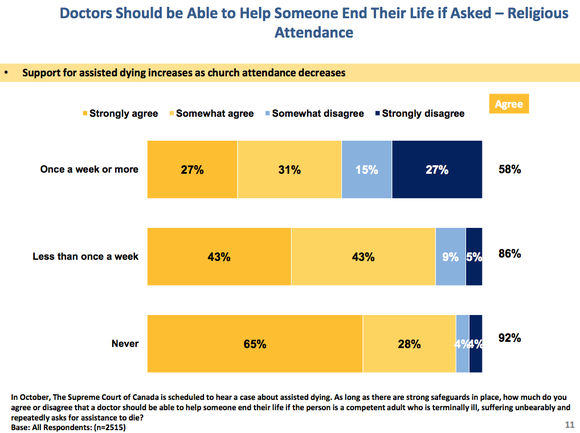
• The largest divergence in support was by degree of church attendance. Those who attend church most frequently are least likely to support assisted dying. While even those who attend church once a week or more are still in support overall, the size of that majority (58%) is smaller than for those who go less frequently (86%) or never (92%).

DWD_churchattendance_canada

Those who never attend a church were most in support of legalizing assisted dying, with 92% supporting it. Overall though, even the Christian majority in Canada are strongly in support of assisted dying:

• There were high levels of support from both the religious and non-religious. In total 80% of all Christians support assisted dying, including 83% of Catholics support assisted dying. (Sample sizes for other religious affiliations, though reflective of the Canadian population, were too small to draw conclusions.)

Interestingly, church attendance also changes how respondents perceive support for assisted dying across Canadian society:

• Those who attend church more than once a week are much more likely to think most Canadians oppose assisted dying (35%) than those who never do (16%).

An executive summary of the poll is available here. The full poll results can be examined here.